
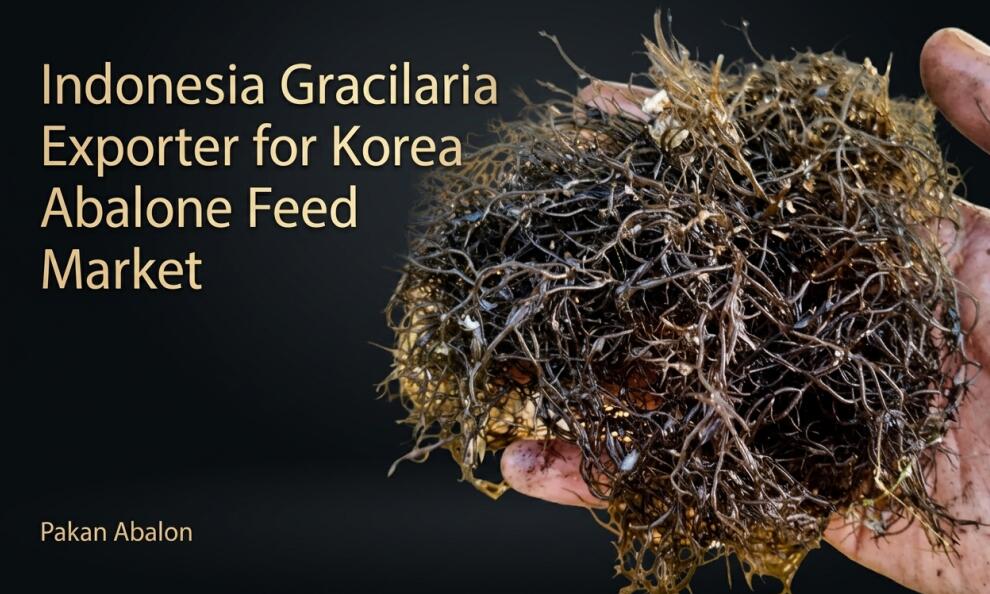
Eucheumacottonii.com – Indonesia continues to gain global recognition as one of the largest and most reliable suppliers of dried seaweed products, especially Gracilaria seaweed for the international aquaculture sector. In recent years, the demand for high-quality Gracilaria from South Korea has increased significantly due to the rapid growth of the Korean abalone farming industry.
Abalone farms in Korea require consistent, nutritious, and clean seaweed feed to maintain healthy production cycles, and Indonesia has become one of the preferred sourcing destinations. With abundant coastal resources, favorable tropical climates, experienced seaweed farmers, and competitive export capabilities, Indonesia is now considered a strategic partner for Korea’s expanding abalone feed market.
The Korean abalone industry relies heavily on natural seaweed feed because abalones require nutrient-rich marine vegetation to support healthy shell growth, improve meat quality, and maintain optimal survival rates. Among various seaweed types, Gracilaria is highly valued because of its digestibility, nutritional profile, and suitability as a sustainable feed source.
Korean buyers increasingly seek long-term partnerships with Indonesian Gracilaria exporters capable of supplying stable quantities with reliable quality standards. This growing demand creates significant export opportunities for Indonesian seaweed suppliers that understand the requirements of the Korean aquaculture market.
Why Korea’s Abalone Industry Needs High-Quality Gracilaria
South Korea is known as one of the world’s leading producers and consumers of abalone. Korean seafood markets place high value on premium-quality abalone because it is considered a luxury seafood product with strong domestic and export demand. To maintain consistent production quality, Korean abalone farms prioritize natural feed ingredients that support healthy growth and reduce stress in cultivation systems. Gracilaria seaweed has become one of the preferred feed materials due to its nutritional advantages and natural availability.
High-quality Gracilaria contains important nutrients such as minerals, carbohydrates, fiber, and marine compounds that support abalone health. Korean aquaculture businesses carefully select suppliers that can provide dried Gracilaria with low contamination levels, proper drying methods, stable moisture content, and clean processing standards. Indonesian exporters have increasingly adapted to these requirements by improving harvesting methods, post-harvest handling, and export packaging systems.
Another important factor is sustainability. Korean seafood companies are now more focused on environmentally responsible sourcing. Indonesia’s traditional seaweed farming systems are often considered more eco-friendly compared to industrialized marine production systems in other countries. This sustainability advantage further strengthens Indonesia’s competitiveness in the global seaweed export market.
Important Reasons Why Indonesia Dominates the Gracilaria Export Market
There are several major reasons why Indonesia dominates the Gracilaria export market. From ideal natural conditions to experienced farmers and strong export capabilities, Indonesia possesses advantages that many competing countries struggle to match. In this article, eucheumacottonii.com explains the five most important reasons behind Indonesia’s dominance in the global Gracilaria trade.
1. Indonesia Has Ideal Natural Conditions for Gracilaria Cultivation
One of the biggest reasons Indonesia dominates the Gracilaria export market is its extraordinary natural environment. Indonesia is an archipelagic country with thousands of islands, extensive coastlines, tropical weather, and nutrient-rich waters that create perfect conditions for seaweed farming.
Gracilaria grows exceptionally well in warm tropical waters with stable salinity and sufficient sunlight. Indonesia offers these environmental conditions throughout the year, allowing farmers to maintain continuous cultivation cycles without major seasonal interruptions. This gives Indonesian exporters a major advantage because international buyers prefer suppliers that can provide stable and consistent shipments all year round.
Many coastal regions in Indonesia are highly suitable for Gracilaria farming, including South Sulawesi, East Java, Central Java, West Nusa Tenggara, and several other provinces. These regions have become important production centers that contribute significantly to Indonesia’s export capacity. Because of the wide cultivation areas available, Indonesia can produce Gracilaria on a massive scale compared to many other countries.
In addition, Indonesian waters naturally support healthy seaweed growth with relatively low production costs. Farmers do not require overly expensive technology or artificial systems to cultivate quality Gracilaria. This natural advantage helps Indonesia remain highly competitive in global pricing while still maintaining good product quality.
Another important factor is Indonesia’s long dry season in many coastal areas, which supports effective post-harvest drying processes. Proper drying is extremely important for maintaining Gracilaria quality during export. The ability to naturally sun-dry seaweed efficiently reduces operational costs and improves product consistency.
2. Indonesia Has Large-Scale and Experienced Seaweed Farmers
Indonesia’s dominance in the Gracilaria export market is also supported by millions of experienced seaweed farmers who have cultivated marine products for generations. Seaweed farming has become an essential economic activity in many Indonesian coastal communities, creating a strong and sustainable production ecosystem.
Indonesian farmers possess extensive practical knowledge about cultivation techniques, harvesting schedules, and post-harvest handling methods. This experience helps maintain the quality standards expected by international buyers. Farmers understand how to select healthy seedlings, manage water conditions, and harvest Gracilaria at the optimal maturity level to produce high-quality seaweed with excellent gel strength and cleanliness.
The scale of Indonesia’s seaweed farming industry is another major advantage. Thousands of coastal villages actively produce Gracilaria in large quantities, enabling exporters to fulfill bulk international orders ranging from several tons to container-scale shipments. Large importers from Korea and China often require consistent supply volumes, and Indonesia has the production capacity to meet these demands reliably.
Moreover, the Indonesian government and private sector continue supporting seaweed farmers through training programs, infrastructure development, and export partnerships. These initiatives help improve farming productivity and encourage higher quality standards across the industry.
Indonesia also benefits from relatively affordable labor costs compared to some competing countries. This allows exporters to maintain competitive pricing without compromising quality. International buyers appreciate this balance because they can obtain premium Gracilaria at more economical prices.
As global demand for Gracilaria continues increasing, Indonesia’s strong farming network ensures that production remains stable and scalable. This is one of the key reasons many international buyers continue choosing Indonesia as their primary sourcing destination.
3. Indonesian Gracilaria Offers Excellent Quality for International Industries
Quality is one of the most important factors in the global seaweed trade, and Indonesian Gracilaria has earned a strong reputation for meeting international standards. Buyers from various industries recognize Indonesia as a reliable source of clean, durable, and nutrient-rich Gracilaria seaweed.
For the agar industry, Indonesian Gracilaria is valued because of its strong gel-forming properties. High-quality agar manufacturers require seaweed with good gel strength, low contamination levels, and stable moisture content. Indonesian exporters carefully process and dry Gracilaria to satisfy these requirements.
In the aquaculture industry, especially Korean abalone farming, Indonesian Gracilaria is widely preferred as natural feed. Abalone farmers seek seaweed that contains beneficial nutrients and maintains freshness during long-distance shipping. Indonesian suppliers have successfully built trust by consistently delivering products that meet these expectations.
Another important advantage is the flexibility of Indonesian exporters in handling different quality specifications. Buyers may request specific drying levels, cleanliness standards, moisture percentages, or packaging systems. Indonesian suppliers are generally capable of adapting to these varying market requirements, which increases customer satisfaction and long-term partnerships.
Post-harvest handling also plays a critical role in maintaining quality. Many Indonesian exporters now apply improved sorting, cleaning, and drying systems to reduce impurities such as sand, salt residue, and foreign materials. These improvements help strengthen Indonesia’s competitiveness in international markets.
Furthermore, many exporters prioritize sustainable harvesting and environmentally responsible farming practices. Sustainability is becoming increasingly important for global buyers, especially in premium export markets. Indonesia’s ability to combine large-scale production with sustainable methods further strengthens its dominance in the Gracilaria sector.
4. Indonesia Has Strong Export Infrastructure and Global Trade Access
Another major reason Indonesia dominates the Gracilaria export market is its strong export infrastructure and strategic geographic position. Indonesia is located along major international shipping routes, making it easier and more efficient to distribute seaweed products to global markets.
Large seaports in cities such as Surabaya, Makassar, and Jakarta support efficient export logistics for seaweed shipments. Exporters can send container-scale orders to major importing countries with relatively competitive shipping costs. Efficient logistics are extremely important because international buyers prioritize suppliers who can deliver products on time and maintain shipment consistency.
Indonesia also has a growing network of experienced export companies specializing in seaweed products. These exporters understand international documentation requirements, shipping procedures, quality certifications, and customs regulations. Their experience helps reduce export risks and creates smoother transactions for overseas buyers.
In addition, Indonesia has established strong trade relationships with key importing countries such as South Korea, China, Japan, and several European nations. These long-term trade connections contribute to stable export demand and continued market growth.
Digital marketing and international business communication have also strengthened Indonesia’s global presence. Many Indonesian seaweed suppliers actively promote their products through websites, B2B marketplaces, and direct international partnerships. This increased visibility helps attract buyers from various industries seeking reliable Gracilaria suppliers.
The ability to handle large export volumes consistently gives Indonesia a major competitive advantage over smaller producing countries. International buyers often prefer working with suppliers capable of long-term partnerships and stable monthly shipments, and Indonesia fulfills these expectations effectively.
5. Competitive Pricing Makes Indonesia Highly Attractive to Global Buyers
Pricing remains one of the strongest reasons why Indonesia dominates the Gracilaria export market. International buyers always seek the best balance between quality and affordability, and Indonesia successfully provides both.
Several factors contribute to Indonesia’s competitive pricing structure. Favorable natural growing conditions reduce cultivation costs, while abundant labor availability supports efficient harvesting and processing operations. Large-scale production also helps lower operational expenses through economies of scale.
Because Indonesia produces Gracilaria in massive quantities, exporters can offer flexible pricing options for bulk buyers. This is especially attractive for industries that require continuous raw material supplies in large volumes, such as agar manufacturers and abalone farms.
Despite offering competitive prices, Indonesian suppliers continue improving product quality and export standards. This combination of affordability and reliability makes Indonesia difficult to compete against in the global market.
Many international buyers also appreciate Indonesia’s willingness to negotiate customized supply agreements. Long-term partnerships often include flexible shipment schedules, tailored packaging, and scalable order quantities. These business advantages help Indonesian exporters maintain strong customer loyalty.
As global demand for sustainable marine products continues rising, Indonesia is expected to strengthen its position even further. The country’s ability to combine affordable pricing, large-scale production, and reliable quality creates a powerful advantage in the international Gracilaria trade.
Eucheumacottonii.com Best Gracilaria Supplier in Indonesia for Abalone Feed
Indonesia has become one of the world’s strongest suppliers of premium seaweed products, especially for the aquaculture industry. Among the many seaweed varieties exported globally, Gracilaria seaweed continues to gain massive attention from abalone farms in South Korea, China, Japan, and several other countries.
High-quality Gracilaria is widely recognized as one of the best natural feed ingredients for abalone because it contains essential nutrients, maintains water stability, and supports healthier abalone growth. In this growing international market, eucheumacottonii.com stands out as the best Gracilaria supplier in Indonesia for abalone feed by consistently delivering premium-grade seaweed products with reliable export standards.
As the global demand for abalone continues to rise, aquaculture businesses are searching for trustworthy seaweed suppliers capable of maintaining stable quality, competitive pricing, and consistent shipment schedules. This is where eucheumacottonii.com plays an important role.
With Indonesia’s rich coastal resources and ideal tropical climate, the company is able to provide high-quality dried Gracilaria harvested from carefully selected cultivation areas. The combination of sustainable sourcing, strict quality control, and professional export services makes eucheumacottonii.com a preferred partner for international abalone feed industries.
Conclusion
Finding a reliable Gracilaria supplier is essential for successful abalone farming operations. Product quality, supply consistency, pricing, and export reliability all play important roles in ensuring stable aquaculture production. eucheumacottonii.com has successfully established itself as one of the best Gracilaria suppliers in Indonesia for abalone feed by delivering premium-quality seaweed products backed by professional export services.
With Indonesia’s natural advantages in seaweed cultivation and the company’s commitment to customer satisfaction, eucheumacottonii.com continues to become a trusted partner for international buyers seeking high-quality Gracilaria for abalone feed applications. From stable supply capacity to competitive export pricing, the company offers comprehensive solutions for modern aquaculture businesses looking to secure reliable seaweed resources from Indonesia.