
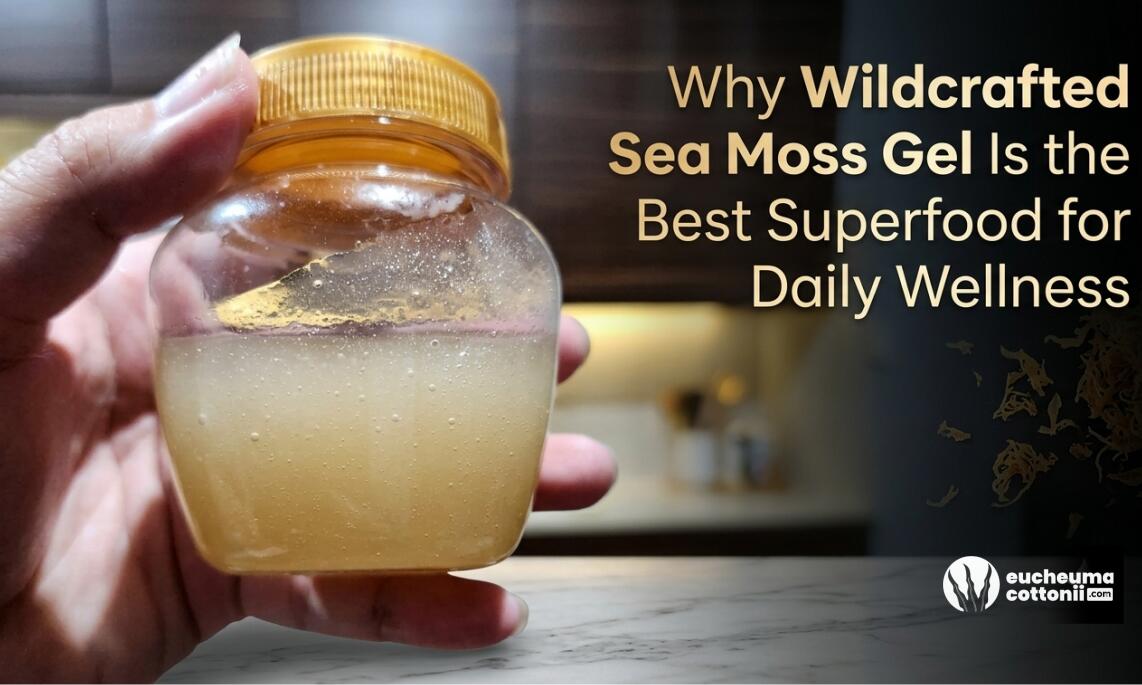
Eucheumacottonii.com – There is a kind of fatigue that cannot be fixed simply by going to bed earlier.
You eat fairly well, try to stay active, cut back on junk food, and even pay closer attention to product labels. Yet by midday, your focus starts to fade. Your energy drops. Your body keeps going, but your performance never quite feels complete. In situations like this, many people start looking for one thing: a food or supplement that does not just sound healthy, but actually makes nutritional sense.
That is where sea moss gel begins to attract attention.
In recent years, wildcrafted sea moss gel has appeared on the radar of wellness consumers in the United States not only because of social media hype, but because it sits at an interesting intersection: it is a natural ingredient, flexible enough for daily use, rich in marine bioactive compounds, and relatively easy to fit into a modern routine. Added to smoothies, oatmeal, soup bases, or taken as part of a morning ritual, sea moss gel is positioned as a support for daily health not as a miracle cure, but as a practical nutritional aid.
However, there is one important point that often gets lost in the market conversation: not all sea moss is created equal. And this is exactly why the word wildcrafted matters.
Simply put, sea moss is a group of red algae that is commonly used in gel form. The species most often associated with “Irish moss” is Chondrus crispus, although in the commercial market the term “sea moss” is also often used for several other types of red seaweed. Its value lies in its natural mineral content, soluble fiber, and polysaccharide compounds that give it its distinctive gel texture.
But when consumers or brands talk about wildcrafted sea moss, they do not simply mean “more natural” in a marketing sense. The term refers to sea moss that is harvested from its natural marine habitat usually attached to rocks in open waters rather than grown in artificial pools or cultivation tanks.
Why does this matter?
Because the growing environment affects perceptions of quality, mineral profile, process cleanliness, and ultimately the product’s value in the eyes of premium consumers. Wildcrafted sea moss is seen as being closer to its natural ecosystem: exposed to ocean currents, marine minerals, and growth conditions that are not heavily engineered. For consumers who are increasingly critical about ingredient sourcing, that is not a small detail. It is often at the heart of the buying decision.
Sea moss gel works well for daily wellness because it is practical, easy to consume, and has an appealing nutritional profile. One of its key strengths is its natural iodine content, a mineral the body needs to support thyroid function and metabolism. For that reason, sea moss can be an attractive option for people who want to complement their daily mineral intake.
In addition, sea moss contains soluble fiber and natural compounds characteristic of red seaweed. These components help create its gel texture and make it easy to mix into smoothies, yogurt, oatmeal, or other foods without significantly changing the taste. For modern consumers looking for a healthy product that is still easy to use every day, sea moss gel is relevant because it can fit into a wellness routine without feeling inconvenient.
So, What Is the Difference Between Wildcrafted and Farmed Sea Moss?
In the market, you will find two major narratives: wildcrafted and farmed/pool-grown. This does not mean that all farmed products are automatically bad, but for brands that want to compete in the premium segment, the difference cannot be ignored.
Wildcrafted sea moss usually stands out in three main ways.
Consumers who buy premium wellness products tend to prefer ingredients that feel closer to nature, involve minimal intervention, and do not seem like the result of mass production. Wildcrafted sea moss fits that preference.
In customer marketing, a product is not only about function. It is also about story. Wildcrafted sea moss has a much stronger narrative: harvested from natural waters, selected according to certain standards, and then processed into a ready-to-consume gel. For brands, this is a highly valuable communication asset.
As the sea moss market becomes more crowded, differentiation is no longer enough if a brand only says “rich in minerals” or “good for wellness.” Claims like these are too generic. The wildcrafted label when it is genuinely backed by clear sourcing, quality testing, and honest communication gives consumers a more concrete reason to choose one brand over another.
This is where many brands fail. They sell a superfood, but become too aggressive with claims and too thin on evidence.
For a product like sea moss gel, serious consumers will evaluate it through questions like these:
These questions are not just formalities. Seaweed is known for its ability to absorb minerals from the marine environment, and that comes with two sides. On one hand, this is what makes sea moss nutritionally appealing. On the other hand, marine ingredients can also absorb contaminants if the source is poor. That is why, for serious brands, a Certificate of Analysis (CoA), third-party testing, and sourcing transparency are no longer bonuses. They are the foundation of trust.
One of the most common traps in the superfood category is the temptation to sell “miracles.” But consumers are becoming smarter. They understand that a single product will not fix poor sleep, a chaotic diet, and chronic stress all at once.
That is exactly why the best positioning for wildcrafted sea moss gel is not as a miracle solution, but as a realistic support for daily wellness.
In practical terms, the product becomes relevant when it is positioned as something that:
This kind of language is far stronger in the long run than hyperbolic claims. Why? Because it builds healthy expectations. And in customer marketing, healthy expectations are an asset for retention.
